
Many Muslims in the UAE and around the world have questions about zakat on gold. Some own gold jewellery they wear daily; others have pieces they rarely or never wear. Some hold gold bullion or investment coins for savings, while others are gold traders and gold business owners. Despite their different situations, they all share the same fundamental questions:
Is zakat due on this gold? And how do I calculate zakat on gold correctly?
Understanding the rules of gold zakat is not just a religious obligation, it is also part of managing your savings wisely and consciously. In this complete guide, Gold Era answers all your questions about zakat on gold and silver clearly and with reliable, well-sourced information.
Key Takeaways:
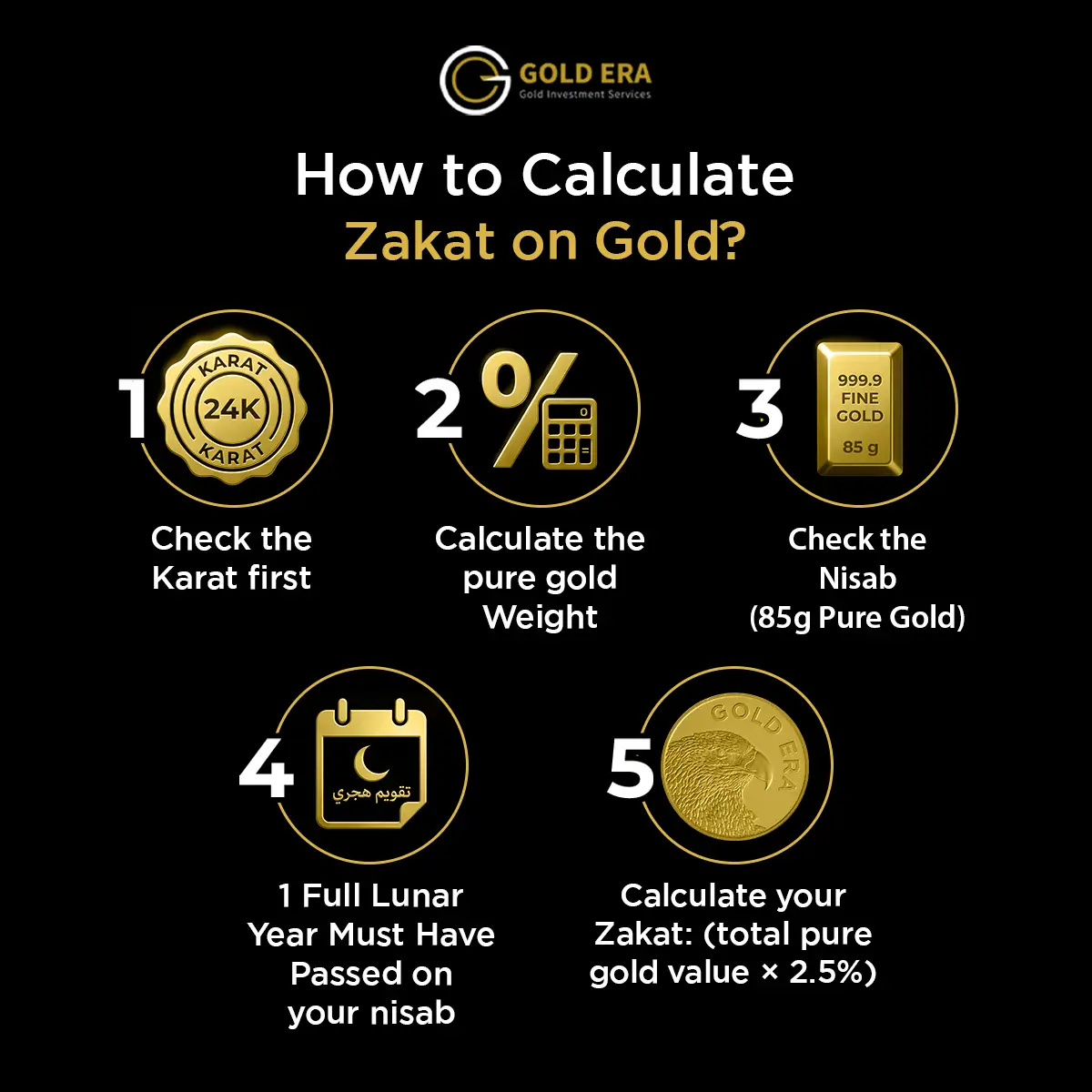
- The nisab (minimum threshold) for zakat on gold is 85 grams of pure gold (24 karat). Zakat is only due if your gold reaches this threshold and a full lunar year (haul) has passed.
- Gold jewellery worn for personal use is not subject to zakat according to the majority of Islamic scholars, though paying it is the safer and more cautious choice if the nisab is reached.
- Gold bullion and investment coins held for saving or investment are subject to zakat.
- The zakat rate on gold is 2.5% of the total value of pure gold, calculated at the market price on the day zakat is paid.
- The core formula: Pure gold weight = (gold piece weight × its karat) ÷ 24 — then multiply by the price of 24K gold per gram, and then take 2.5%.
- Stored gold and trade gold are both subject to zakat, calculated based on market value at the end of the lunar year.
- Zakat on silver: The nisab is 595 grams of pure silver (999 fineness), and the zakat rate is also 2.5%.
What Is Zakat on Gold?
Zakat is one of the Five Pillars of Islam. It is obligatory on specific types of wealth, including gold and silver. The majority of Islamic scholars agree that gold owned for saving or investment is subject to zakat once the required conditions are met.
Zakat on gold is the Islamic obligation due on gold that has reached the nisab and upon which a full lunar year (haul) has passed.
The nisab is the minimum threshold of wealth or gold below which zakat is not required. The haul means one complete lunar year. In the context of gold zakat, it is the amount that must be paid from gold (or its equivalent cash value) once all conditions for payment are fulfilled.
What Is the Nisab for Zakat on Gold?
The Islamic shariah sets the nisab at 20 mithqal of gold. Islamic scholars have defined the weight of a mithqal and what its equivalent nowadays, and the nisab today is calculated as 85 grams of pure gold (24 karat). This is the minimum threshold at which zakat becomes due.
To calculate the nisab value in your local currency, multiply 85 grams by the current market price of one gram of 24K gold on the day you pay zakat.
Conditions for Zakat on Gold to Be Due:
- The pure gold must reach the nisab (85 grams of pure gold)
- A full lunar/Hijri year must have passed since the gold reached the nisab
- The gold must be fully and freely owned, with no debts that would reduce it below the nisab
- The nisab must remain complete throughout the entire year without falling below it until the day zakat is paid
Which Types of Gold Are Subject to Zakat?

Gold comes in several forms and is owned for different purposes. Some people own gold jewellery for adornment; others hold gold as a saving method or a safe investment; and some are professional gold traders. Gold also comes in different karats: 24K, 22K, 21K, and 18K, which raises a common question: does the zakat calculation differ by karat, or is the rate always the same?
Below, we break down the gold zakat rules for each situation.
1. Zakat on Gold Jewellery for Personal Use
This is one of the most frequently asked questions about zakat, particularly among women. When it comes to gold jewellery worn regularly for personal adornment, there are two established scholarly opinions:
1- The Majority of Scholars:
Zakat is not due on gold jewellery that is worn and used regularly for personal adornment — such as rings, bracelets, and necklaces — because it is treated similarly to consumable personal property. However, this exemption applies only when the following conditions are all met:
- The use must be permissible. If a man is wearing gold jewellery, zakat is due on it regardless.
- The jewellery must be worn with the genuine intention of adornment. If it is kept without being worn, or the intention is saving or trade, zakat becomes due.
- The jewellery must remain in wearable condition. If it is broken or damaged and unfit for use, it is treated as non-worn gold and zakat applies from the date it became unusable. If it is repaired or recast, the exemption resumes.
- The quantity must be within reasonable and customary limits. If the amount of jewellery reaches a level considered extravagant or excessive, zakat is due on whatever exceeds the reasonable threshold.
2- The View of Imam Abu Hanifa and Some Scholars:
Zakat is due on worn jewellery regardless of its purpose or intention, because gold is fundamentally a form of wealth.
Finally, both opinions have strong scholarly evidence. The safer and more cautious approach is to pay zakat on gold jewellery when able, once it reaches the nisab.
2. Zakat on Gold Not Worn (Unworn Gold)
Gold that is not worn — whether inherited, received as a gift, or simply sitting unused — is subject to zakat if it reaches the nisab and a full lunar year has passed on the nisab.
3. Zakat on Stored Gold (Savings and Investment Gold)
Stored gold held for savings or investment — such as gold bullion (ingots) and investment gold coins — is unambiguously subject to zakat if it reaches the nisab and a full lunar year has passed on the nisab. There is no islamic scholarly disagreement on this point.
4. Zakat on the Gold Trade
This category is especially important for gold shop owners, gold companies, and gold investors in the UAE. Gold that is held for sale or trade — whether bullion, coins, or jewellery — is treated as trade goods. Zakat is calculated as follows:
- Value the entire gold inventory at market price on the day zakat is due, at the end of the haul or one full lunar year.
- Deduct any outstanding debts if applicable.
- If the net value reaches the nisab, calculate and pay 2.5% to the established channels of zakat
How Much Is Zakat on Gold? The Rate of Gold Zakat
The zakat rate on gold — and on all zakatable wealth — is one-quarter of one-tenth, or 2.5%. It may be paid in the currency of the country where the owner resides or where the assets are held.
The Gold Zakat Formula
Core formula: Weight of pure gold (grams) × price of 24K gold per gram × 2.5%
How to Calculate Zakat on Gold by Karat
Since zakat on gold is based on pure gold content which is equivalent to 24 karat gold, the following conversion formula is used for gold of other karats:
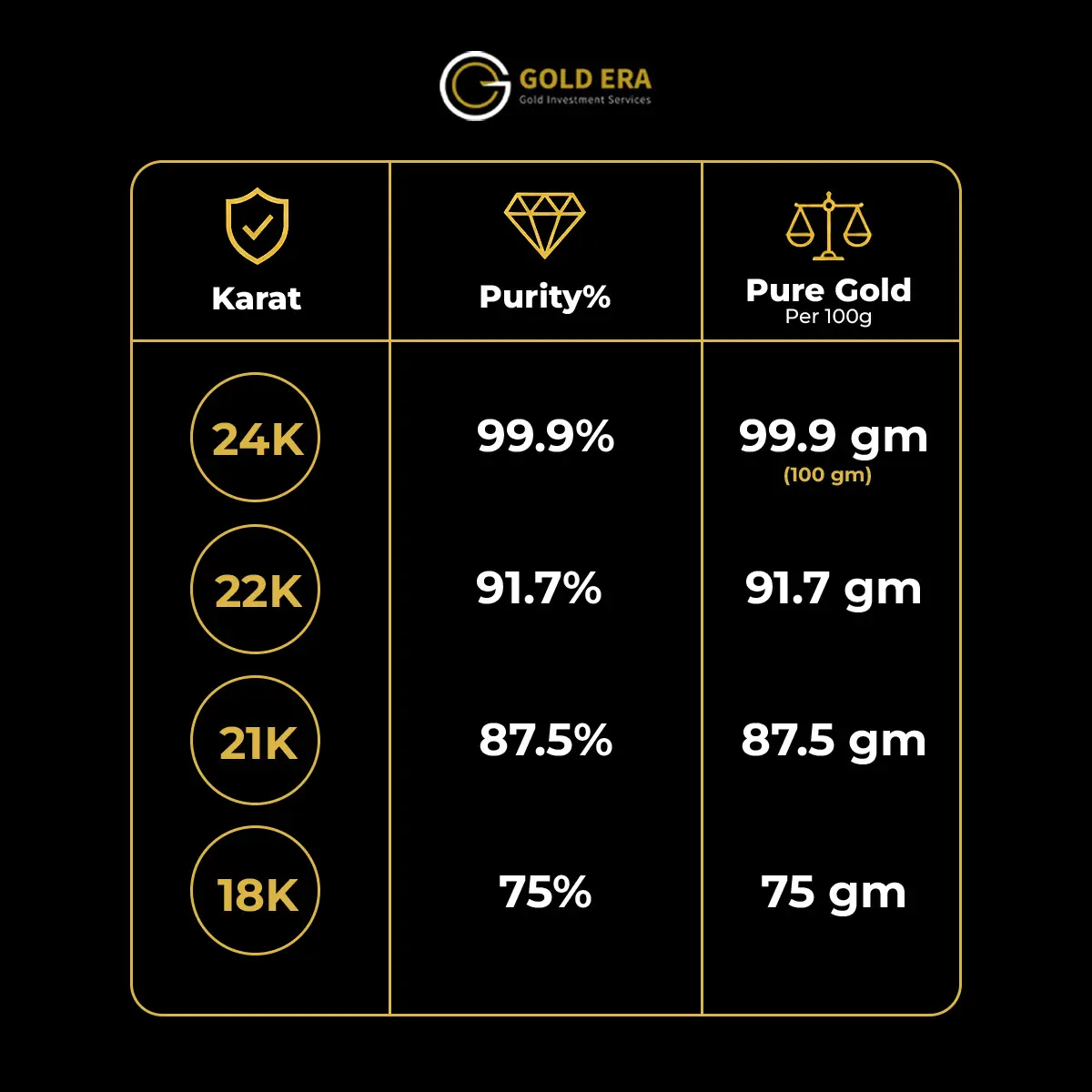
Pure gold weight = (gold piece weight × its karat) ÷ 24
1- How to Calculate Zakat on 24 Karat Gold
24K gold is the purest form of gold (99.9% pure gold), and it is what Gold Era’s investment bullion and gold coins are made from. Zakat on gold is always calculated based on the 24K gold equivalent value.
Practical example to calculate the zakat on 24K gold:
- If the gold weight = 100 grams, 24 karat
- Pure gold content = (100 × 24) ÷ 24 = 100 grams
- Price of 24K gold per gram = AED 566.50 (indicative price for illustration only. Use the actual market price on the day you pay zakat)
- Total gold value= 100 × 566.50 = AED 56,650
- Zakat due: 56,650 × 2.5% = AED 1,416.25
2- How to Calculate Zakat on 21 Karat Gold
21K gold is the most common karat used in Gulf and UAE jewellery, with a pure gold content of 87.5%.
Practical example to calculate the zakat on 21K gold:
- If the gold weight = 100 grams, 21 karat
- Pure gold content = (100 × 21) ÷ 24 = 87.5 grams
- Price of 24K gold per gram: AED 566.50 (indicative price for illustration only. Use the actual market price on the day you pay zakat)
- Total gold value = 87.5 × 566.50 = AED 49,568.75
- Zakat due: 49,568.75 × 2.5% = AED 1,239.22
3- How to Calculate Zakat on 18 Karat Gold
18K gold is also widely used in jewellery, with a pure gold content of 75%.
Example 1 to calculate the zakat on 18K gold:
- If the gold weight = 100 grams, 18 karat
- Pure gold content = (100 × 18) ÷ 24 = 75 grams
- 75 grams is below the nisab of 85 grams of pure gold, So there is No Zakat due in this case
Example 2 to calculate the zakat on 18K gold:
- If the gold weight = 200 grams, 18 karat
- Pure gold content = (200 × 18) ÷ 24 = 150 grams
- Price of 24K gold per gram = AED 566.50 (indicative price for illustration only. Use the actual market price on the day you pay zakat)
- Total gold value = 150 × 566.50 = AED 84,975
- Zakat due: 84,975 × 2.5% = AED 2,124.38
The following infographic explain the pure gold content for each different gold karat
Zakat on Silver
Zakat is due on pure silver owned for saving, investment, or trade, including silver bullion (ingots), silver coins, and silver ornaments held for investment, provided the nisab is reached and a full lunar year has passed on the nisab. Zakat is not due on silver jewellery worn for personal adornment.
The nisab for silver is five silver Awqiya (a classical measurement unit of weight), equivalent to 200 silver dirhams of pure silver, which equals 595 grams by today’s weight standards.
If you hold 595 grams or more of pure silver for investment, savings, or trade, and a full lunar year has passed, zakat is due. The zakah rate is the same: 2.5% (one-quarter of one-tenth).
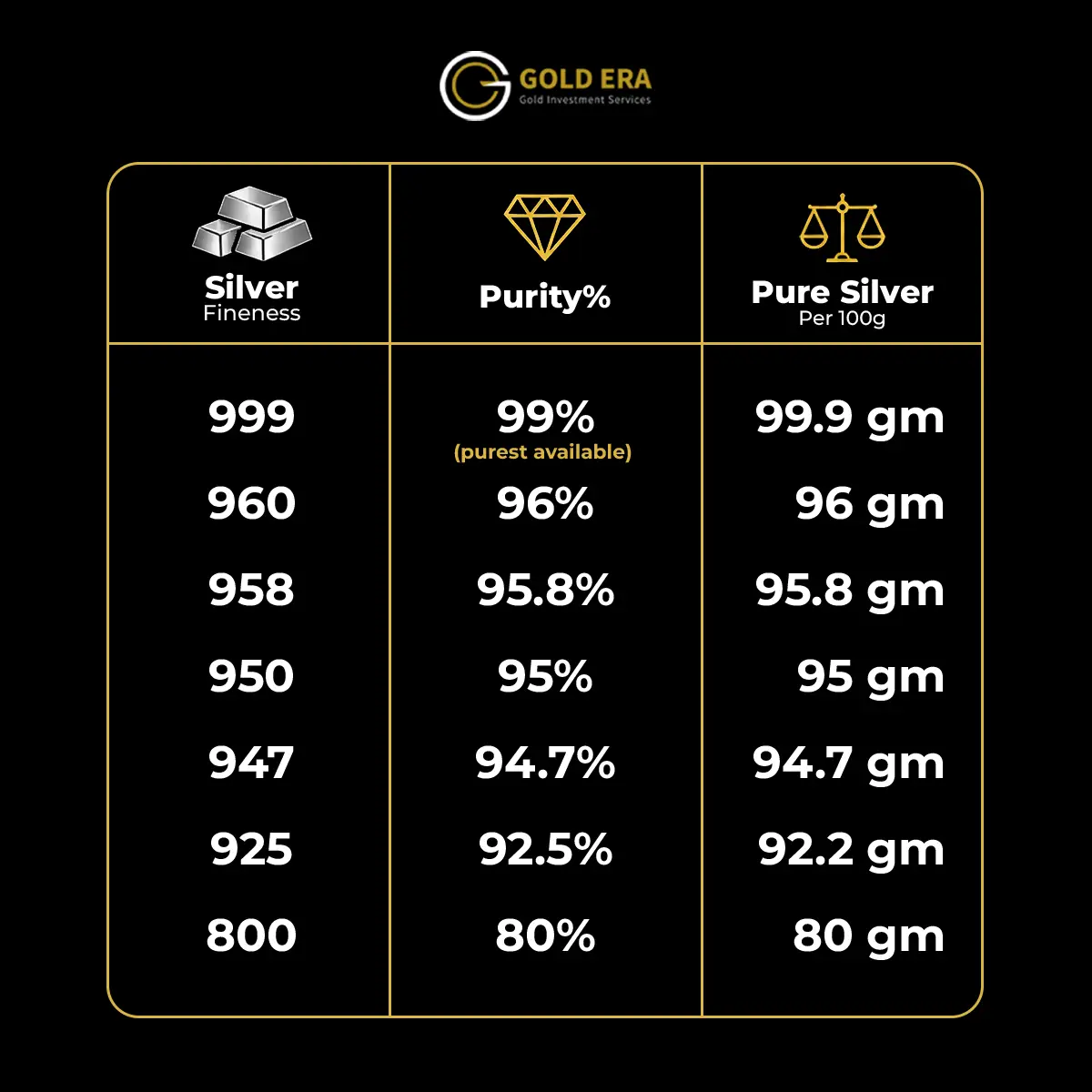
Pure silver for zakat purposes means the 999 fineness silver which is the standard used in investment-grade silver bullion today.
Following is a reference table for silver purity by fineness
Calculate Zakat on Gold Online
You can easily calculate your gold zakat in the UAE using free online tools, including the official zakat calculator provided by the General Authority of Islamic Affairs, Endowments and Zakat in the UAE, or through trusted charitable organizations’ websites that also allow you to pay your zakat directly and securely.
Gold Era Zakat Calculator
Gold Era is one of the UAE’s leading companies in manufacturing and selling 24 karat investment gold bullion, including flat bars and round bullion coins (also known as gold lira) in 24K. We give our customers a secure and transparent way to invest in pure gold to preserve and grow their savings.
Zakat rules apply to Gold Era’s 24K gold bullion, investment coins, and our distinctive 24K gold pendants, all of the highest purity available.
If you invest in Gold Era gold bullion and own more than 85 grams of gold with a full lunar year having passed, you can use the Gold Era Zakat Calculator on our website to calculate your gold zakat easily, accurately, and in minutes.
FAQs About Zakat on Gold and Silver
1. Is zakat due on gold that has not been owned for one lunar year?
No, a full lunar year (Haul) is a prerequisite. If a full year has not passed since you acquired the minimum amount of gold required for zakat (Gold Nisab), then no zakat is due on it until a full year has passed.
2. Can I pay zakat on gold in cash instead of gold?
Yes, Zakat on gold may be paid in gold or its equivalent in cash at the market price at the time of paying zakat.
3. Is the zakat on gold bullion different from the zakat on jewelry?
The zakat calculation method is the same, both are calculated regarding the pure gold equivalent (24K basis). The difference is that gold bullion is undeniably subject to zakat, while gold jewelry is not subject to zakat according to the majority of islamic scholars.
4. When should zakat on gold silver be paid?
There is no single fixed date for all Muslims. Unlike fasting or prayer, zakat is not tied to a specific month. It becomes due once the lunar year is complete from the date your gold first reached the nisab. For simplicity, many people choose a consistent date each year — such as the beginning of Ramadan or before Eid — so they never forget.
Conclusion
Zakat on gold is a firmly established Islamic obligation, and not knowing its rules does not remove the duty. Whether you own gold bullion, investment coins, or jewellery and ornaments, the core principle is the same:
- Calculate the weight of your pure gold and determine if it reaches the minimum threshold of 85 grams or not.
- Value it at the current market price
- Pay 2.5% when the lunar year is complete since you owned the nisab value.
If you are looking for investment gold with transparent purity, guaranteed quality, and straightforward zakat calculation, Gold Era is your trusted destination in the UAE for certified gold bullion and investment coins.
Disclaimer: This article is for general educational purposes. For precise Islamic rulings specific to your situation, please consult a qualified Islamic scholar or an accredited fatwa authority.
Comments are closed