

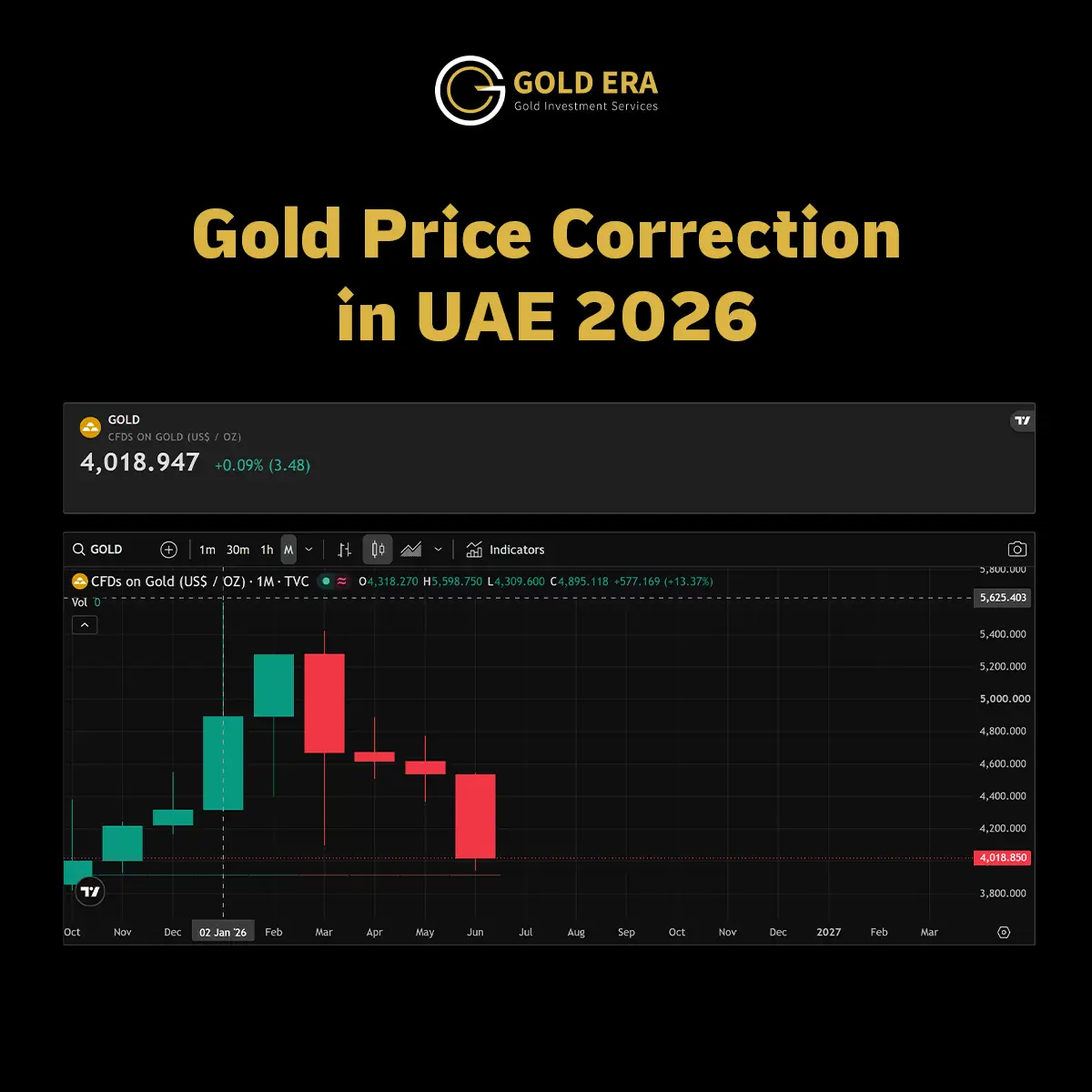
In January 2026, the global gold market witnessed an unprecedented rally. The precious metal shattered records by crossing the $5,000 per ounce milestone, eventually peaking at an all-time high of $5,595 on January 29. Locally, the UAE retail price for 24K gold soared to AED 664 per gram, marking an unforgettable moment for bullion investors.
Since that historic peak, the market has gone through a deeper and more volatile correction than initially expected. By late June 2026, gold had briefly fallen below the $4,000 psychological level for the first time since November 2025, before staging a partial recovery. As of early July 2026, gold trades around $4,150-$4,170 per ounce, representing a decline of nearly 26% from its all-time high. In the UAE, the price of 24K gold now hovers around AED 500 per gram.
While financial headlines frequently use the word “correction,” everyday buyers want to know the practical reality. Is this gold price correction or price drop a warning sign to stay away, or is it a strategic buying window? This guide analyzes the driving forces behind the 2026 market movement and outlines what it means for your wealth protection strategy.
Key Takeaways
- Gold corrected by nearly 26% globally after hitting its peak of $5,595/oz in January 2026, briefly dipping below $4,000/oz in late June before recovering.
- In the UAE, 24K gold is currently over AED 161 cheaper per gram compared to the January highs.
- The gold price correction is driven by specific macro factors: a stronger USD, the Fed holding rates under new Chair Kevin Warsh, and natural profit-taking. It’s not a collapse in gold’s investment case.
- Physical gold demand in Q1 2026 hit a record $193 billion globally. This meant that buyers were accumulating on the dip.
- Major global banks maintain bullish long-term forecasts for the end of the year, though some have trimmed targets as rate-cut expectations faded.
- For UAE buyers, the current market stabilization provides a significantly lower entry point for building physical gold bullion reserves in the UAE.
What Is a Gold Price Correction?
A gold price correction is defined as a short-to-medium-term price decline of 10% or more from a recent peak within an ongoing, healthy long-term bull market. It is a natural market mechanism rather than a structural crash, a healthy part of how asset prices move. Corrections serve to clear out speculative excess, reset market sentiment, and build a stronger foundation for the next upward move.
To put the current correction in context: gold has experienced corrections throughout every major bull market in its history and has gone on to set new highs after each one. The 2008 correction saw gold fall over 25% before resuming its upward trend and eventually reaching new records. The 2020 correction following the post-COVID spike was nearly 20%.
In both historical instances, investors who accumulated physical gold during the correction protected their purchasing power effectively.
Here is the question that actually matters: have the core reasons for owning gold fundamentally changed? Heading into the second half of 2026, the structural data still says no.
What Caused the Gold Price Drop in 2026?
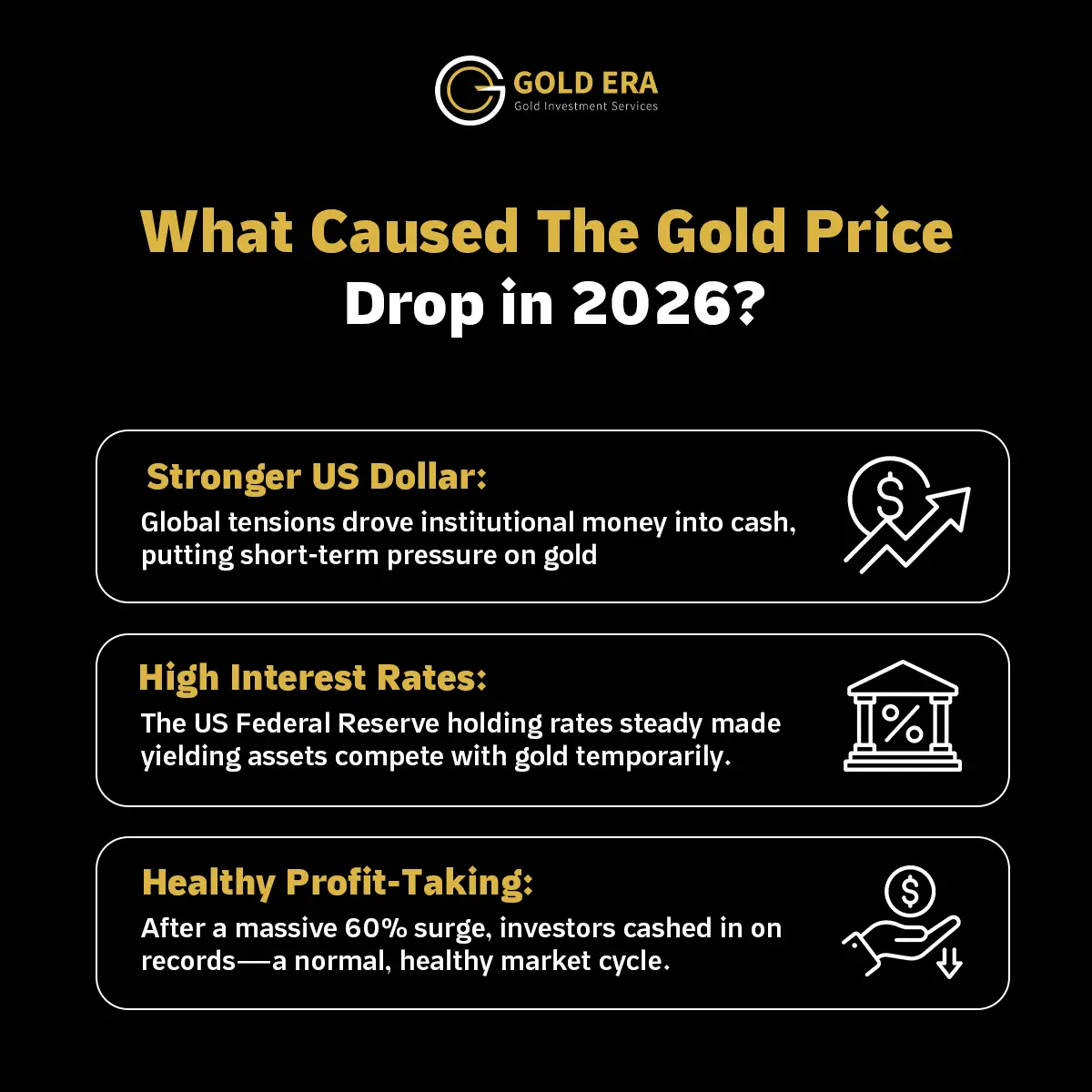
The 2026 price correction was triggered by a combination of macroeconomic factors, and none of them signal a fundamental breakdown in the gold market.
1. A Rebounding US Dollar Index
Gold is priced in US dollars globally. When the dollar strengthens, gold becomes more expensive for buyers holding other currencies, which dampens demand and mechanically pushes the price lower.
The geopolitical escalations in the Middle East earlier this year drove institutional capital toward liquid US dollar assets as an immediate defensive safe haven. This pushed the dollar index above 98.5, exerting sustained downward technical pressure on precious metals.
2. A New Fed Chair and a “Higher-for-Longer” Stance
Gold is a non-yielding asset, meaning it carries an opportunity cost when compared to interest-bearing instruments like government bonds. When interest rates fall, gold becomes highly attractive. Conversely, when rates remain elevated, gold faces headwinds.
Jerome Powell’s term as Fed Chair ended in May 2026, and Kevin Warsh took over as the new Chair. Warsh led his first policy meeting on June 17, 2026, where the Fed held rates steady at 3.50–3.75% for a fourth consecutive meeting. The bigger story was the tone: the Fed’s updated projections showed nine of nineteen policymakers now favoring at least one rate hike by year-end, a sharp reversal from March, when none did. May inflation came in at 4.2% year-over-year, the highest reading in three years, driven largely by energy costs tied to the US-Iran conflict.
That hawkish repricing pushed gold to its lowest levels of the year in June. However, a weaker-than-expected June jobs report (57,000 jobs added versus a forecast of 110,000) in early July caused markets to scale back rate-hike expectations again, with the odds of a hike falling to around 50%, down from roughly two-thirds earlier in June. That shift, along with a softer dollar, helped gold recover off its lows.
3. Standard Profit-Taking After a Historic Rally
Gold had risen approximately 60% in 2025 alone, breaking more than 50 record highs. By January 2026, it had gained another 25% in two months. At some point, even the most convinced investors take profits.
That natural process, which was entirely expected after a run of that magnitude, contributed meaningfully to the pullback. Gold’s decline deepened further in June as the hawkish Fed repricing and dollar strength combined to push the metal to its lowest point of the year — briefly below $4,000/oz in late June, a level not seen since November 2025 — before recovering to current levels above $4,150.
The Numbers UAE Buyers Need to Know
To put this correction into perspective, 24K gold in Dubai is over AED 161 per gram more affordable today than it was during the January peak.
The table below illustrates what this price difference looks like across standard investment sizes:
| Purchase Size | At All-Time High (Jan 2026) | Today (Early July 2026) | Your Direct Savings |
| 1 gram | AED 664.00 | AED 503 | AED 161 less |
| 5 grams | AED 3,320.00 | AED 2,515 | AED 805 less |
| 10 grams | AED 6,640.00 | AED 5,030 | AED 1,610 less |
| 100 grams | AED 66,400.00 | AED 50,300 | AED 16,100 less |
| 1 kilogram | AED 664,000.00 | AED 503,000 | AED 161,000 less |
Note: Table prices reflect market approximations for 24K gold in the UAE in early July 2026. Please note that gold prices can move meaningfully day to day.
Is the Gold Price Rally Over or Is This a Buying Window?
Leading global market data suggests that the current environment is a period of consolidation rather than a permanent trend reversal, even though short-term volatility has been higher than initially expected.
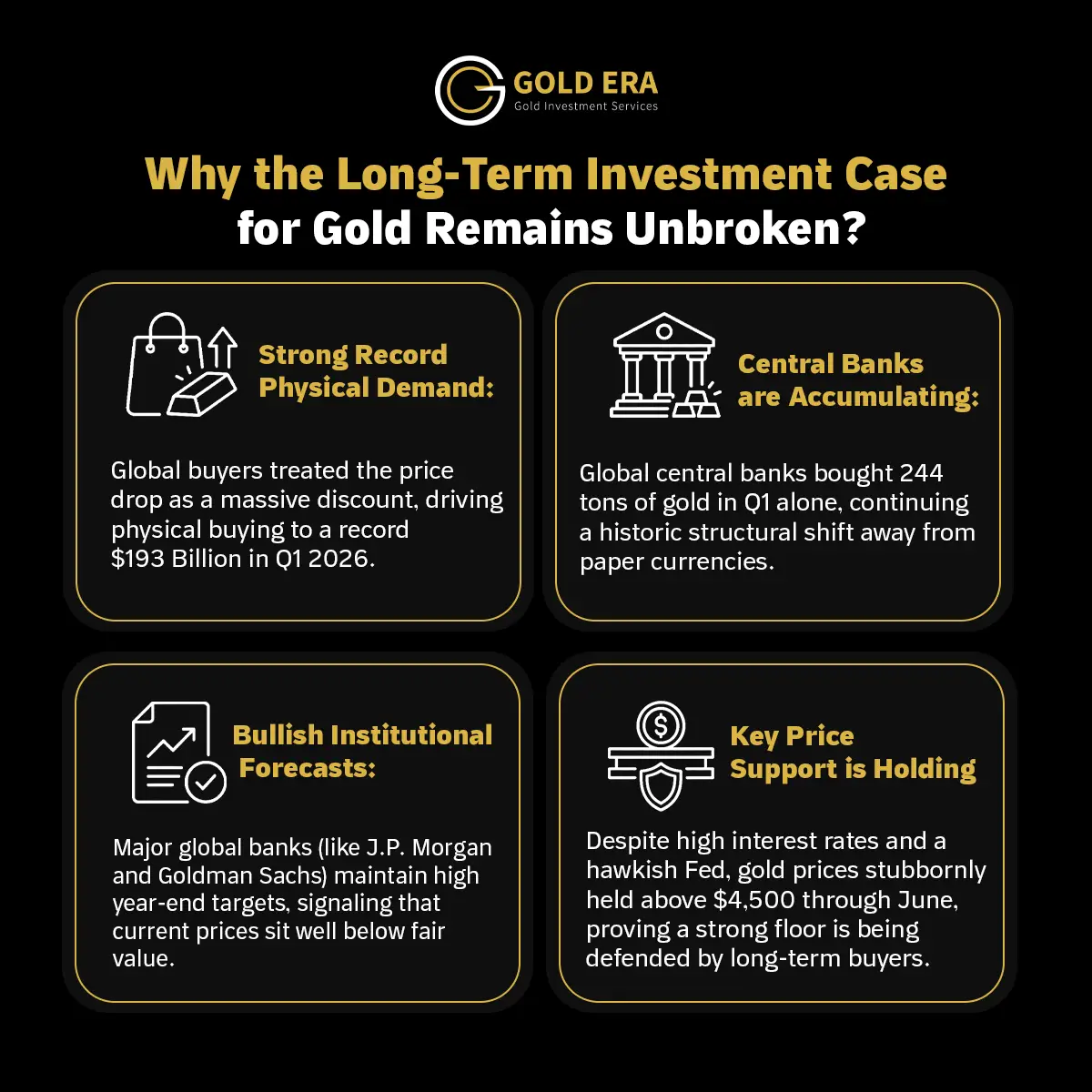
Several key indicators confirm that the long-term investment case for gold remains fully intact:
1- Physical demand stayed strong through the correction
The World Gold Council reported that total gold demand in Q1 2026 reached 1,231 tonnes. Which is worth a record $193 billion, up 74% in value year-on-year.
Bar and coin demand specifically rose 42% to 474 tonnes, the second-highest quarterly total ever recorded. When prices fell, physical buyers did not retreat, but they bought more.
2- Central bank demand remained elevated
Central banks net-purchased 244 tonnes in the first quarter of 2026, up 3% year-over-year. The structural shift in global reserve management has not reversed away from the US dollar and toward gold.
The dollar’s share of global central bank reserves has dropped from over 60% to approximately 40%, while gold’s share has tripled to around 30%.
3- Strong Institutional Forecasts
Wall Street’s largest institutions have not fully backed away from their bullish outlooks, though some have trimmed their target forecasts to adapt to the Fed’s “higher-for-longer” stance under Kevin Warsh. However, their revised numbers still point to a clear upward trend from today’s lower entry points.
- Goldman Sachs has revised its target down from $5,400 to around $4,900 per ounce.
- JPMorgan’s most recent public outlook (July 3, 2026) now projects gold to settle around $4,300 in Q3 2026, before rising to $4,500 by Q4 2026 which is a sharp cut from its earlier $6,000 year-end target set in June. According to Reuters: “The bank retained a long-term bullish view, saying gold could extend gains in 2027 as central bank purchases and physical demand strengthen amid enduring structural drivers of accumulation.”
- The London Bullion Market Association (LBMA): Their consensus forecast for the 2026 average gold price remains at $4,742 per ounce, as highlighted in the latest LBMA Precious Metals Forecast Survey.
The takeaway? The banks aren’t expecting another wild $5,500 rally tomorrow, but they agree that gold is currently trading below its fair value. For UAE buyers, this minor retreat by big institutions actually confirms that the market is stabilizing at a much healthier, discounted entry point.
4. The correction tested key support and gold held above it on a medium-term basis
Let’s be completely upfront: June 2026 wasn’t just a minor dip—it was a real stress test for the market. Gold actually broke below the critical $4,300–$4,350 analyst baseline, briefly hitting a yearly low below $4,000 for the first time since late 2025.
But what happened immediately after is the real story. The market didn’t collapse. Instead, physical buyers and institutions treated the sub-$4,000 mark as a massive discount window. Within days, aggressive dip-buying pushed gold straight back into the $4,150–$4,170 range by early July. Holding the line after such a deep test proves that the market floor is being heavily defended by long-term structural buyers, not just panic-prone traders.
The Reality Check for Buyers: Of course, navigating today’s market requires eyes wide open. The Fed has taken a hawkish, less predictable turn, and sticky inflation driven by the US-Iran situation keeps geopolitical tension high. However, early July’s softer US jobs data (adding just 57,000 jobs against expectations) instantly cooled off those aggressive rate-hike fears.
If you are looking at gold right now, forget about short-term timing or looking for overnight miracles. The next few weeks will face two-sided volatility. But if your horizon is 12 to 24 months, the data shows that you are entering a stabilizing market at a deeply discounted price point that has already tested its worst-case support and survived.
Should You Buy Gold Now or Wait?

Nobody called the January peak. Nobody called the June low either. That is the honest starting point for answering this question.
What we can do is look at where prices are, what the data shows, and lay out the framework clearly so you can make a decision that fits your situation.
The case for buying now:
Prices are roughly 26% below where they were in January. That is a significant discount on an asset with the institutional support gold currently has. Physical demand data shows that central banks, retail investors, and institutional buyers have been accumulating consistently through the correction, including through the deeper June leg down, rather than waiting for lower prices.
And for UAE buyers specifically, the local market conditions are as competitive as anywhere in the world: no VAT on investment gold bars, transparent live pricing, and access to certified 999.9 fine gold without the premiums you would pay in other markets.
The case for waiting:
The short-term picture is genuinely uncertain. The Fed under its new Chair has adopted a more hawkish, less predictable posture, and a rate hike later this year is a real possibility. Oil prices and geopolitical risk remain unresolved. Gold has already shown this year that it can fall meaningfully further and faster than expected; the June low was deeper than most analysts anticipated in the spring. Anyone who tells you with certainty that prices cannot go lower is not being straight with you.
The balanced view:
Investors who buy at current levels and hold for 12 to 24 months are positioned in line with where the weight of institutional forecasts sits. Investors trying to time the exact bottom will likely either miss the move entirely or end up buying at roughly the same price after months of analysis — having gained nothing except stress.
For anyone who finds the timing question genuinely uncomfortable, dollar-cost averaging removes it from the equation. Buy a fixed AED amount at regular intervals — monthly, for example — rather than committing everything at once. You will not buy at the bottom, but you will not buy at the top either. Over 12 to 24 months, your average cost per gram will reflect the range, not a single moment of anxiety.
Gold Era’s full range [from 1 gram bars to 1 kilogram bullion] is built for exactly this kind of systematic approach.
What Type of Gold Makes Sense to Buy During a Price Correction?
When gold prices undergo a correction, acquiring investment-grade bullion gives you the most direct exposure to the eventual market recovery. Unlike decorative jewelry, pure investment-grade gold allows you to pay purely for the weight of the metal itself, eliminating heavy, non-refundable manufacturing or design fees. Therefore, during such times, it is highly recommended to purchase 24K investment-grade gold, which is available in various forms and weights as follows:
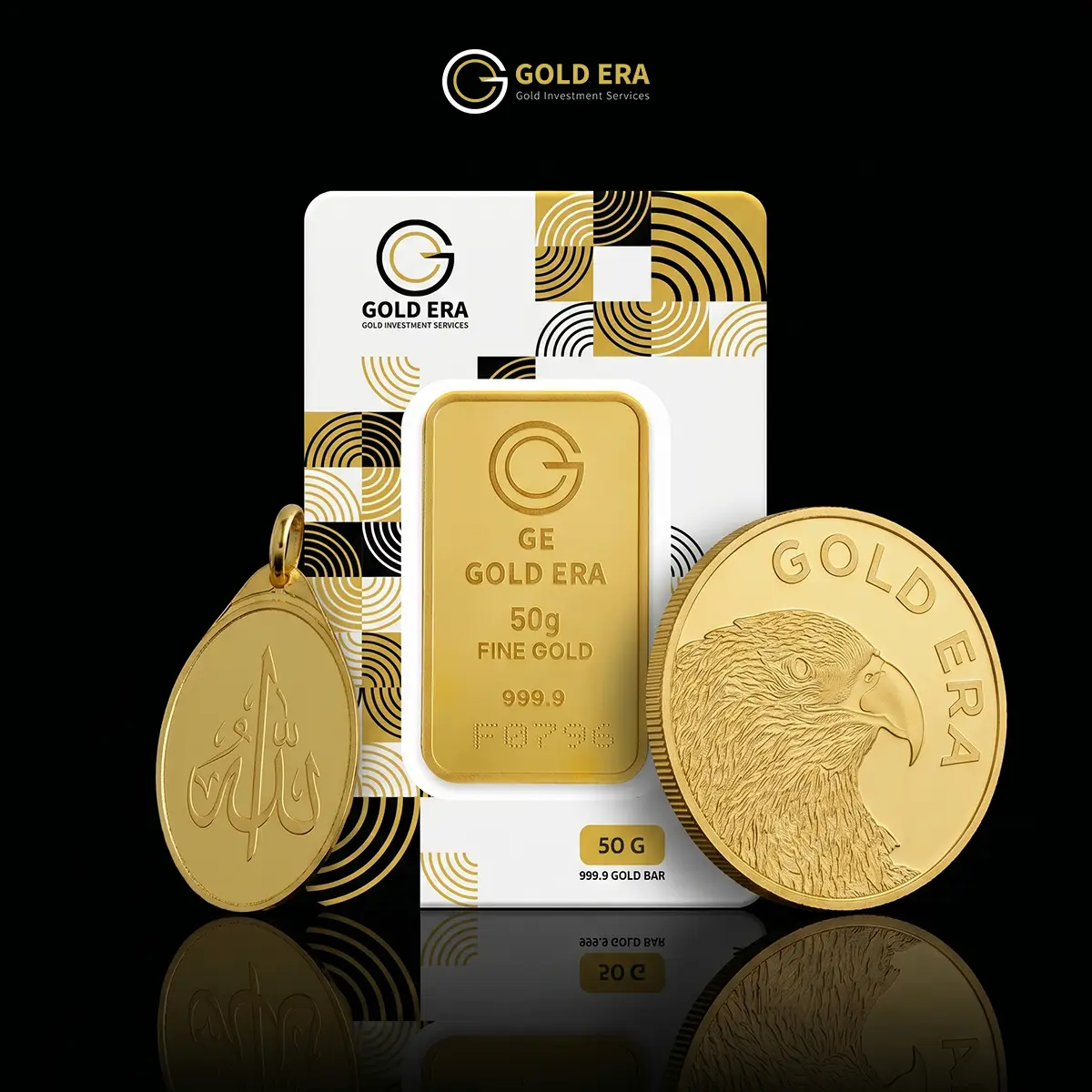
- Gold bars and Ingots: These represent the most cost-efficient method for building gold reserves. Gold Era offers 24K gold bars (999.9 fine gold) from 1 gram to 1 kilogram, which allows investors and beginners to start small and add systematically. During a gold price correction, smaller bar increments (5g, 10g, 20g) are particularly useful for a dollar-cost averaging approach.
Check out our complete Gold Bars Buying Guide for what to check before you buy.
- 24k gold coins and bullion rounds: These minted bullion pieces provide the same 999.9 fine gold content in a convenient, recognizable format. They are the standard choice for investors who want flexibility: coins are easy to sell in part, easy to store, and carry the same spot-price exposure as bars.
- Gold pendants: Gold necklaces and jewelry are a top choice as meaningful and valuable gifts for many occasions, such as newborn gifts, wedding gifts, graduation gifts, and more. Therefore, purchasing 24-karat gold necklaces during this period of lower gold prices ensures you acquire a beautiful, wearable investment asset at a significantly lower cost per gram compared to the beginning of the year.
For a broader overview of gold investment formats, see Gold Investment Guide UAE.
Where to Buy Gold in the UAE During a Price Correction?
When navigating a volatile market, choosing a certified partner is critical. Dubai ranks among the top two physical gold trading hubs globally which allows local buyers to access investment-grade 24K gold under some of the most competitive conditions worldwide including zero VAT on investment bars.
To maximize your returns, always prioritize:
- Purity certification: Every piece should be stamped and certified 999.9 (24K)
- Transparent pricing: Price per gram should be tied to the live Emirates suggested retail rate.
- Traceability: Reputable dealers provide documentation with every purchase.
- Range: Access to multiple weights allows you to manage position size and budget.
Gold Era provides an ecosystem built for secure wealth protection. All Gold Era bars, investment coins, and fine pendants are crafted to international standards. To help our clients make the most of this price correction, all Gold Era bars weighing 20 grams and above feature completely free packaging with zero hidden fees, meaning every dirham you allocate goes directly into buying pure, unadulterated gold.
At Gold Era, we give you the flexibility to secure your wealth your way. Enjoy the convenience of 24/7 secure ordering via Gold Era e-store, or get complete peace of mind by inspecting the weight and purity of your gold in person. Whichever you prefer, our team welcomes you to our website or our physical showrooms located in Dubai and Abu Dhabi, where transparency and security are always guaranteed.
FAQ
1- Why is the gold price dropping in 2026?
The gold price correction reflects three converging factors:
- A stronger US dollar following the US-Iran conflict.
- The Federal Reserve, under new leadership, held interest rates steady while signaling a possible hike, amid elevated inflation (4.2% in May 2026).
- Natural profit-taking after gold’s extraordinary 60%+ gain in 2025.
These are specific, identifiable causes and not a breakdown in gold’s long-term investment case.
2- Will gold prices go up again in 2026?
The broader consensus among global financial institutions points toward a recovery in the second half of the year. While banks have naturally lowered their initial targets to adapt to a hawkish Fed, their revised numbers still project a clear upside. For instance, Goldman Sachs targets around $4,900/oz by year-end, while J.P. Morgan retains a long-term bullish outlook, noting that gold could trade between $4,300 and $4,500 by Q4 and extend its gains into 2027. Backed by record-breaking physical demand and ongoing central bank buying, the data suggests that gold is currently stabilizing and building a healthy foundation for its next upward move.
3- Is now a good time to buy gold in UAE?
For buyers with a medium-to-long-term horizon (12 months or more), current prices represent a lower entry point supported by strong underlying fundamentals, even after accounting for the deeper-than-expected June pullback.
For short-term speculation, further volatility is possible in either direction.
4- Is gold a good investment in 2026?
Historically, gold has delivered an average annual return of approximately 7.78% since 1971. In 2025 alone it returned over 60%. The structural drivers remain in place: central bank accumulation, dollar debasement concerns, geopolitical uncertainty, and inflation hedging.
The 2026 gold price correction including its deeper June leg has not changed the underlying thesis. As with any asset, timing and entry price matter, and no investment is without risk.
5- What is the difference between gold bars and gold coins for investment?
Both options offer the opportunity to own 24-karat investment gold with a purity of 999.9. However, their practical differences lie in design, weight ranges, and premiums:
- Gold Bars: Contrary to popular belief, gold bars offer the widest weight flexibility, starting from as small as 1 gram up to 1 kilogram. Because of their simpler manufacturing process, bars typically carry the lowest premium (making them the most cost-effective way to buy pure gold by weight). Smaller bars (1g to 20g) are also perfect for a budget-friendly, step-by-step investment strategy.
- Gold Coins and Rounds: These feature intricate artistic, cultural, or historical designs (such as sovereign coins or local commemorative editions). While they offer excellent liquidity and are highly recognizable, they usually start at larger standard weights (like 2.5 grams or 5 grams) and carry a slightly higher manufacturing premium than bars due to their detailed minting process.
Conclusion
The gold price correction of 2026 turned out to be deeper and more volatile than it looked back in May. Nearly 26% off an all-time high, including a brief dip below the psychologically important $4,000 level in June, is not a small move. But the context matters enormously.
Gold rose 60% in 2025, broke 50 consecutive records, and surged another 25% in the first month of 2026. A gold price correction of this magnitude, after a run of that scale — even one that briefly broke below key support before recovering — is consistent with a market functioning normally, not one sending a distress signal.
The data that matters most — physical demand, central bank buying, institutional forecasts, and UAE market conditions — all continue to point in the same direction: the structural case for gold remains intact, and prices are currently sitting at a meaningfully lower level than they were six months ago.
For UAE investors and buyers, the question is not whether gold prices will be higher in five years. The historical record on that is clear. The question is whether the current window suits your timeline, budget, and risk profile.
Gold Era offers 24K gold bars, coins, and pendants — all certified 999.9 fine gold — available in multiple weights to suit different investment sizes. Pricing is aligned to the live Emirates spot rate.
Explore Gold Era Shop & Find the Right Gold Investment Now
Disclaimer: This article is for informational purposes only and does not constitute financial advice. Gold prices are subject to market fluctuation and past performance does not guarantee future results. Please consult a qualified financial advisor before making investment decisions.
Comments are closed